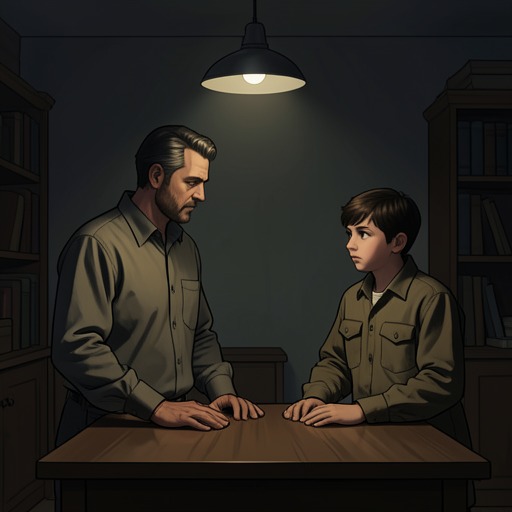
Tooru Kamiya and his father
Even If This Love Disappears From the World TonightTooru Kamiya and his father are bound by a history of loss and unspoken resentment, but their relationship begins to change when Tooru challenges his father’s retreat from family life and writing. The turning point is not a sudden reconciliation: it is a difficult exchange about what the father avoided, what his children carried in his place, and how a family might begin again through honesty and ordinary work.
Identity and Background
Tooru and his father share a household marked by the absence of Tooru’s mother and by the lasting consequences of that loss. Tooru remembers that when he and his sister, Sanae Kamiya, needed a father, their father was not there for them. He cannot bring himself to say this aloud at first; the accusation remains physically contained in a clenched fist. That silence captures the central difficulty between them: the wound is clear to Tooru, but naming it would mean risking a confrontation with the parent he still needs.
Their history is also shaped by an unequal division of domestic responsibility. The father later admits that he ran from housework and left Sanae and Tooru to do it. His children’s practical labor was therefore not incidental to the estrangement: it was one way his withdrawal became part of their daily life. Tooru can acknowledge the hurt without reducing his father to it, a distinction that becomes essential to their eventual exchange.
The father’s identity is divided between his role as a working parent and his unrealized aspiration to become a novelist. He has stopped submitting his writing to contests, but has not fully relinquished the image of himself as a struggling author. Tooru’s confrontation makes that contradiction explicit: the dream still matters to his father, yet fear of failure has become a reason not to act. Their bond is tested by whether either can face this truth without confusing criticism with rejection.
The Conversation That Changes Their Course
The immediate setting for Tooru’s intervention is the Kamiya family apartment kitchen, where his father waits after Tooru returns to the apartment complex after nine. A laptop and a can of low-malt beer sit beside him, and his expression is somber. He has just learned online that the Akutagawa Prize has been awarded to Keiko Nishikawa, a name he recognizes; seeing the photograph from the press conference, he realizes that the young author is Sanae. He asks Tooru whether he knew.
The news brings the family’s separate histories into one conversation. Tooru recognizes that Sanae worked hard for their sake for a long time and kept the family together from her first year of junior high. He insists that she must now be allowed to follow her own path. The recognition is painful because it sharpens his memory of what their father failed to provide. Yet Tooru does not let the exchange settle into accusation alone. His father has supported the household through work, and Tooru can tell him that he and Sanae are grateful for that support even while insisting that gratitude cannot substitute for facing the past.
Tooru identifies the father’s retreat as fear: he has not submitted his writing because he does not want to be hurt by the result. He urges him to risk failure and learn from it rather than remain protected by inaction. The argument also turns toward Tooru himself. Thinking of the hardship Sanae has faced, he wonders whether he will run away just when he has a chance to change something in his own life. He wants to become someone Hino can feel proud of; the thought leads him to follow his father and grab his shoulder. His intervention is therefore both an appeal to his father and a test of the courage Tooru wants to practice.
The father’s answer is not defensive denial. He concedes that Tooru is right and admits that, after losing Tooru’s mother, he feared discovering that he lacked the ability to write. He had run from that possibility, as well as from housework and reality more broadly. In accepting the criticism, he can finally apologize for a long pattern rather than arguing over a single failure. The exchange gives Tooru a chance to say two truths together: his father failed them in important ways, and he has also worked long hours to support them and is, in Tooru’s words, a good father. The relationship begins to move forward when neither truth has to erase the other.
Reconciliation Through Shared Work
After the conversation, the father asks Tooru to make something. The evidence does not specify what they make, but the request turns their difficult talk toward a small act of cooperation. Later, they clean up the dishes together. The domestic scene matters because it reverses the pattern the father has confessed to: he is no longer leaving all the work to his children. Reconciliation takes material form in a kitchen task, not only in an apology.
Their contact with Sanae also begins to change. The landline, which almost no one ever calls, rings at nearly ten; the father looks puzzled, then recognizes what the call may mean and glances at Tooru. Tooru nods, and his father answers nervously. After listening, he sniffles and congratulates Sanae from the bottom of his heart. His emotion gives the prize news a family consequence: he is not merely identifying his daughter’s success from a photograph but speaking to her directly and acknowledging it.
Sanae calls again a few days later. Since that second call, the father has been in high spirits. Beginning the morning after his conversation with Tooru, he helps with chores. He attempts to cook, gets it wrong, and tries again with Tooru’s help, learning little by little. On the day Sanae visits, he has been cleaning since morning and boasts that he will cook dinner. These repeated efforts show change as a practice: he enters tasks he previously avoided, accepts that he may not do them well at first, and allows his son to help him learn.
He describes this as having turned over a new leaf and says that cooking and cleaning are enjoyable once tried. He also clarifies that he is taking a break from writing, not abandoning it as an escape. He wants to wait until he can truly face himself in his work before starting again. Offering Sanae books from his collection, including first editions, and saying that he needs to pare it down, he makes room for her independent life while reconsidering his own priorities. His new approach does not promise an immediate return to authorship; it replaces avoidance with a deliberate pause and renewed participation in the family.
What the Relationship Makes Possible
The shift between father and son is part of a wider family repair. Tooru’s father had left Sanae and Tooru carrying domestic responsibilities after their mother’s death, while Sanae’s achievement makes visible how much she had done to hold the family together. Tooru’s defense of her right to pursue her own path helps redirect his father’s attention from his private disappointment toward the children whose lives his withdrawal affected. The father’s congratulatory call and his later help around the home are concrete responses to that recognition.
The relationship is not presented as a simple reversal in which apology cancels the past. Tooru retains the memory that his father was absent when the children needed him, and his father acknowledges that he ran from household duties and from the risk of discovering his limits as a writer. Their more hopeful bond depends on holding injury and gratitude together: Tooru can name his father’s failure without denying his support, and the father can accept responsibility without insisting that his sacrifices settle the matter.
Their reconciliation also changes what family support looks like. In another part of Tooru’s life, the devotion and self-sacrifice of his parents and Izumi make it possible for Maori to graduate from high school and attend art class several times a week, an opportunity she had given up before her accident. That later account places parental care in the realm of sustained, practical effort. In Tooru’s own household, the father’s new contribution begins with chores, cooking attempts, and renewed contact with Sanae: modest actions that answer an earlier absence without pretending to undo it.
The bond’s significance lies in this movement from silence to truthful participation. Tooru risks hurting his father by challenging him; his father responds by admitting what he had avoided. Their subsequent shared work and the father’s emotional congratulations to Sanae do not make the family’s history disappear. They make it possible for the family to act differently within that history, with Tooru and his father no longer relating only through the old wound or through unspoken obligation.